
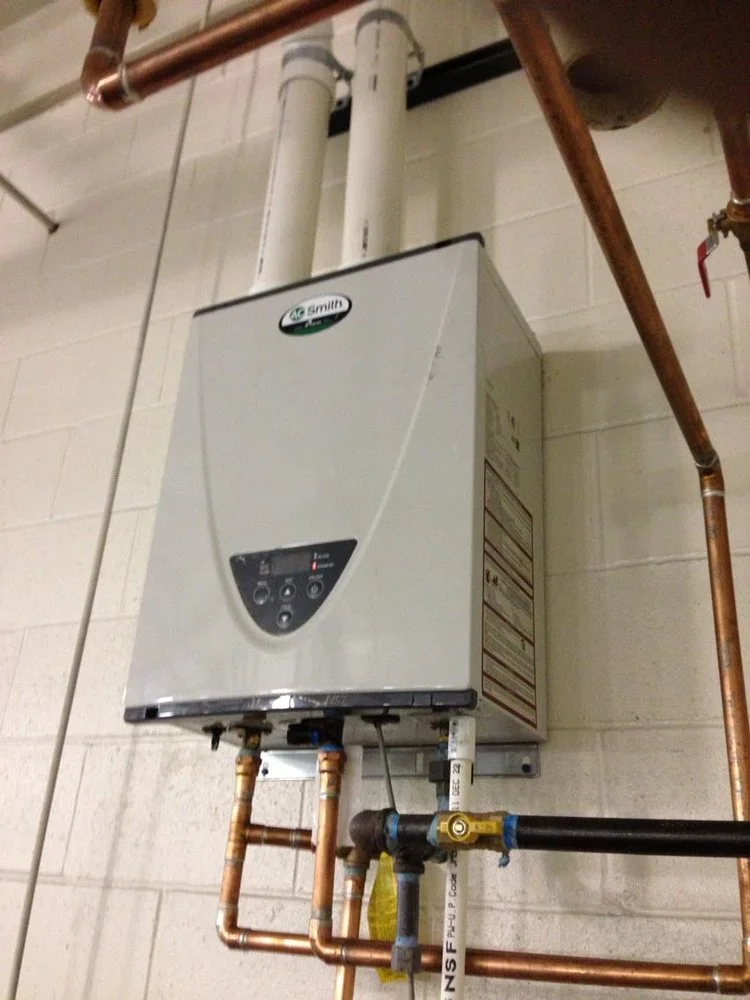
Does the standard tankless-versus-tank advice survive contact with a Spicewood property — well water, propane, a co-op power line that blinks in every good storm, and maybe a house that sits empty four days a week? Mostly no. The city math changes out here in ways that flip the answer house by house, so this is the Spicewood version: same technologies, different referee.
Installed and code-complete, a 40–50 gallon propane or electric tank runs $1,300–$2,600 in the Spicewood area; propane tankless lands $2,000–$3,500 when the fuel line and venting cooperate and $3,500–$6,500 when they don't. The rural premium is real but usually modest — drive time folds into quotes — and the propane wrinkle matters more: a tankless burner wants up to 199,000 BTU, which means verifying your regulator, line sizing from the pigtail on, and whether the tank itself can feed that draw alongside the furnace in January. That verification visit is free information; skipping it is how conversions go over budget. Electric tankless ($1,400–$3,000) is usually a non-starter out here — the amperage it demands is exactly what rural panels and long utility runs don't have to spare.
City-water tankless advice obsesses over scale; well-water tankless advice adds sediment and iron. Hill Country wells pull hard water by default — scale is still the main enemy, and the $150–$250 annual descale still applies — but grit and iron also foul the inlet screen and, over time, the heat exchanger. The working setup for well-water tankless is a sediment filter ahead of the unit and ideally a softener; with both, a tankless is a legitimate 20-year appliance out here. Without them, plan on more frequent service than any brochure admits. Tanks are more forgiving of grit (it just joins the sediment layer) but pay for it in lifespan: 8–12 years, low end in untreated water, against 20+ for maintained tankless.
Here's the asymmetry nobody in town mentions: when the power blinks out on a co-op line, a gas tank keeps making hot water (standing pilot models) or at least keeps 50 hot gallons in reserve — while a tankless of any fuel type goes dark, because its brain, fan, and igniter are electric. No power, no hot water, period. On a generator-equipped property that's trivia; the tankless draws little and rides the backup fine. On a property without one, it means every multi-hour outage is also a cold-shower event. Weigh that against the tank's own outage risk — a power surge when the line comes back can take out an electric tank's elements — and the outage column goes: gas tank first, generator-backed tankless second, electric anything last.
Sizing is the whole game — gas line, vent path, GPM demand. Beaver matches Spicewood homeowners with a licensed, vetted plumber who quotes both options in one visit, free.
Tankless units mounted on exterior walls or in ventilated closets carry freeze-protection heaters — which, note the irony, need electricity, so an extended winter outage (Spicewood remembers) can freeze the very unit protecting itself. Interior mounting or a hard-plumbed drain-down option is the rural answer. For weekend and lake places the tankless argument strengthens: no reason to keep 50 gallons hot for an empty house Monday through Thursday, no standby loss, nothing stored to leak while nobody's there to hear it — a wall unit plus a shutoff routine beats a tank quietly aging in an empty utility room. If you do keep a tank at a part-time place, vacation mode and a smart leak sensor with a phone alert are the minimum insurance.
The endless-hot-water promise is rationed by GPM, and winter well water arrives cold enough to cut any unit's effective output. Size for the property's real simultaneous demand — two showers and a washing machine on a busy Saturday at the lake house is a bigger draw than the same house's Tuesday — and remember that guests are a plumbing load: the weekend-place tankless should be sized for the house full, not the house average.
On well water the retirement signs come with local accents. Rumble and pop is sediment — and untreated well water builds the layer fast, so a five-year-old tank can sound like a city tank at ten. Rust-tinted hot water gets a caveat out here: iron-bearing wells tint both taps, so compare hot against cold before blaming the tank — hot-only discoloration is the anode/tank-wall story, both-taps is the well's. Dampness at the base means the countdown is running, and at a weekend place that countdown runs unsupervised — which is why the leak sensor earns its ten dollars. A tank past ten, on untreated water, at a part-time property, is the full bingo card; quote its successor this season, not after.
Run a lightly-used lake house through both columns. Tank: ~$1,900 installed, replaced once in twenty years (light use is kind), but heating 50 gallons around the clock for a house that's empty most of the week — standby loss is the whole utility story at a part-time place, and vacation-mode discipline is the variable nobody maintains from 40 miles away. Tankless: ~$3,200 installed (propane work included), minus the $600 25C credit on condensing models, plus descales the treatment train stretches to every few years — and a standby cost of approximately nothing, because the unit only runs when someone's there to shower. For full-time homesteads the columns roughly tie, same as in town; for weekend places the tankless column wins on its own terms — provided the power-outage and freeze-protection caveats above are engineered, not ignored.
Five questions keep a rural quote honest: Can my propane system feed 199k BTU alongside the furnace in January — regulator, line, and tank? Where does the unit mount, and what's the freeze plan if power fails? What treatment goes ahead of it — sediment, softener — and what does that add? What GPM at winter well temperature, sized for the house full of guests? If we stay with a tank: what's the code delta, and does the pan drain somewhere real? Crisp answers mean a system bid; vague ones mean you're buying the installer's learning curve.
Choose a tank when outages are frequent and there's no generator, when budget leads, or when the house is lightly and constantly occupied. Choose tankless when the property has backup power or reliable service, when it's a part-time place that shouldn't store hot water for nobody, or when you're building the well-water treatment train (sediment filter, softener) anyway — at which point the 20-year lifespan is real. Either way, make the tankless quote itemize propane-line verification and venting, get the tank quote in the same visit, and decide while the current heater still gives you the luxury of choosing — rust-tinted hot water and rumble are its resignation letter.