
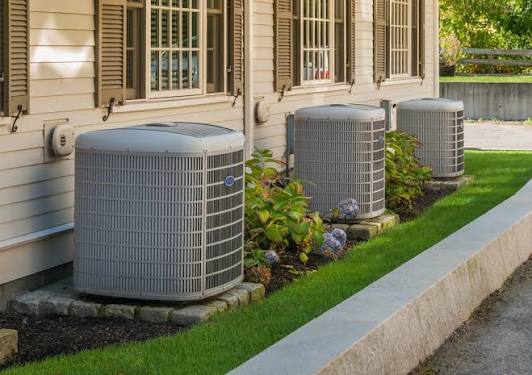
The county's AC lifespan question comes with local footnotes the brochures never print: rural power that ages electrical components ahead of schedule, cabin systems old enough to run refrigerant that's priced like contraband, weekend places whose failures compound unattended between Fridays, and service distances that convert every unplanned ending into a logistics event. The honest numbers survive the footnotes — 10–14 maintained years remains the range — but the county's path through them is its own: here's the full map, R-22 endgame included.
The base range holds — 10–14 years maintained, 8–12 neglected — with the county's amendments: the rural-power surcharge (outage-restart cycles and voltage sags taxing capacitors, contactors, and boards — the electrical tier exiting a season or two early on unprotected service, with surge protection buying much of it back for $150–$300); the housing spread (new builds aging on brochure-adjacent clocks, vintage cabins on their own archaeology); and the maintenance-access reality — the far-west triage math making the neglected system's failures cost waiting on top of money, which converts the maintenance multiplier from virtue to strategy. Component clocks run the regional standard, rural-adjusted: capacitors 4–7 county years (the post-storm seasons harvesting them), fan and blower motors 8–12, compressors defining the endings — and announcing them earliest on the systems that skipped their springs.
The county's vintage-cabin fleet includes the region's most durable survivors — 20-year systems still grinding through Augusts on original compressors — and the survivors run on borrowed economics: R-22 at $100–$250 per pound means any sealed-system event (the leak, the coil, the compressor) prices the funeral, not the repair. The honest planning posture: the running R-22 system is a replacement awaiting a date — serviced gently (airflow and electrical kept perfect, since those repairs stay rational), monitored for the decline patterns, and scheduled for its shoulder-season exit before the refrigerant event schedules it for August. The replacement guide's propane-and-heat-pump comparison belongs in the same conversation; the cabin retiring its R-22 relic and its propane furnace in one heat-pump conversion is the county's cleanest equipment story, told weekly.
Beaver matches Spicewood homeowners with a licensed, vetted pro who drives 71 for the honest assessment — free, price quoted before any work.
The decades read regionally with county annotations: 0–5 warranty era (install confessions pursued under coverage — the rural install's commissioning numbers being the paperwork that matters); 5–9 normal metabolism (the capacitor tier, arriving early on unprotected power); 10–12 the decision decade ($5,000-rule math on every repair, with the county's trip reality added to both sides of the equation); 12+ borrowed time — compressor-adjacent anything being a replacement conversation, R-22 anything being one immediately. The convergence test holds — two end-stage symptoms together start the clock — and the county adds its own tell: the system whose every service call costs a 40-minute mobilization has a lower repair-tolerance threshold by pure logistics, which the honest county tech prices into the advice unprompted.
The lake house ages differently, not better: fewer run hours (the away-mode 80–83 economy) against harsher patterns — the freeze event thawing unattended into the pan, humidity sitting in closed rooms between visits, and every small failure compounding for days before discovery. The equalizers are the standing stack: the remote-alert thermostat (the mid-week 85° text being the county's cheapest diagnostic), the confirmed float switch, the annual visit timed to the season's front edge, and the departure checklist's five minutes. Managed so, the weekend system's gentler duty cycle actually banks lifespan; unmanaged, its failures age it in compound interest — the difference being entirely informational, which is the county's whole infrastructure story in one appliance.
The 3–5 year spread between maintained and neglected is worth more per year out here: the $100–$200 spring visit — drive absorbed by corridor-familiar shops — catches marginal charge, tired capacitors, and scaling drains before the triage season prices the same discoveries in waiting plus premiums. The county's extension practice: filters at cedar-season tempo, the condenser excavation as spring rite (oak litter being the county's quietest equipment killer), surge protection fleet-wide including the well house, and the registry habit — every unit's install date in one note, the data plates decoded once, the standing relationship holding the baselines. The false extenders retire on schedule: hard-start kits as bridges only, top-off subscriptions never, additives nowhere.
The parts itemize on county-adjusted schedules — capacitors 4–7 years ($150–$300, post-storm seasons harvesting), contactors similar, fan and blower motors 8–12 ($300–$800), coils 10–15, compressors defining endings — with the tier logic intact: metabolism, messages, conclusions. The outbuilding tier runs gentler: the county's casita-shop-and-barn mini-splits reach 15–20 years on inverter design and small loads, provided the washable filters meet water occasionally and the condensate paths stay honest. The registry habit covers the property: every head, handler, and condenser's birthday in one note — the well-house and pool equipment included — and the whole estate's replacement horizon visible at a glance, which is how county households turn equipment surprises into calendar entries.
Closing arithmetic, county rates: the property's installed cooling — house, casita, shop — runs five figures on staggered clocks, and the managed portfolio (~$150–$400 of annual visits, drives included) replaces on schedule while the unmanaged one meets its endings in August clusters at triage speed. Every table in the cost guide sits downstream of that choice; the county just adds mileage to the wrong side of it. Choose once, calendar it, wave at the tech.
The county's lifespan conversation eventually meets its neighbor: the whole-home generator that keeps systems from the hard stops that age them, the portable tier that keeps refrigerators honest through outage days, and the not-yet answer that most households hold until the first multi-day event votes otherwise. The AC angle is real — soft, managed power is component mercy, and the generator-equipped house skips the restart-cycle tax entirely — but the decision belongs to the household's whole risk math, per the deliberate-conversation doctrine. Have it deliberately; the county's equipment ages by the answer either way.
Real-estate coda, county rates: the listing's systems census — HVAC ages, well equipment, the R-22 question answered — prices before offer per the rural-stack inspection order, and the vintage cabin's "runs great" 18-year-old carries a refrigerant asterisk every honest negotiation reads aloud. Data plates don't lie; decode them first.
The scheduled ending is worth most where the emergency costs most: the county system reading 11–13 with convergence symptoms gets its shoulder-season replacement — crews happy to drive west in October, the full playbook (load calc, matched R-454B, rural line items, commissioning) applied at leisure, the propane comparison run where tanks apply. The alternative — the August failure at far-west triage speed — pays every premium the county levies plus the wait. The short version: county systems live the regional range with rural footnotes, R-22 survivors are replacements awaiting dates, the weekend place ages on information, and the spring visit converts logistics from enemy to non-factor. Age is runtime plus distance out here; schedule both and the equipment behaves.